The Founder's Guide to Hiring Technical Partners: Traditional Agency vs. Freelancer vs. Product Studio
Most non-technical founders lose six figures and six months not because their idea failed, but because they picked the wrong engineering model. Here is how traditional agencies, solo freelancers, and dedicated product studios actually compare.
Why Most Software Projects Fail Before the First Line of Code
When a non-technical founder or operations director decides to build a custom platform—a customer portal, an internal operations tool, or a new SaaS product—their biggest risk is rarely whether the technology is possible. Almost everything a growing business needs is technically solved. The real risk is selecting a delivery model whose incentives quietly work against your timeline, budget, and code quality.
Across technical rescues we are asked to step into at Febin & Dale Ventures, the story repeats almost word for word. A founder spends four to eight months and significant capital with a traditional software shop or a patchwork of contractors, only to end up with a brittle product that breaks whenever a new feature is added—and a codebase nobody left on the project fully understands.
Understanding the structural differences between a traditional agency, a solo freelancer, and a dedicated product studio saves months of burned runway before you sign a single statement of work.
The Three Classic Agency Traps
Traditional software agencies are optimized for utilization margins and account growth—not necessarily for shipping the leanest possible software to validate your business. Three structural failure modes show up consistently:
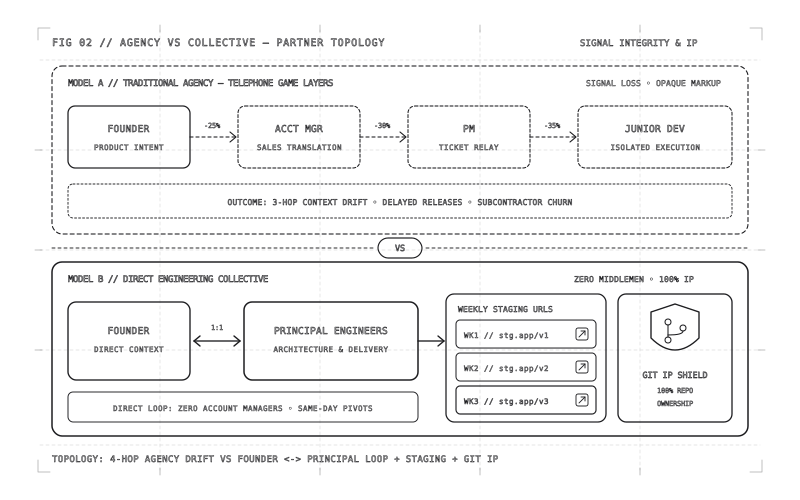
- The Bait-and-Switch & Telephone Game: During sales calls, you speak with an articulate solutions architect and a senior partner. The week after the deposit clears, your project is handed to a non-technical account manager who relays your business nuance as simplified Jira tickets to rotating junior developers you are never allowed to message directly. Nuance gets lost at every hop.
- The Hostage Codebase: Far too many founders discover six months in that their source code lives inside the agency's private Git account, their domain DNS sits under the vendor's registrar login, and cloud infrastructure bills pass through an agency markup. Leaving the relationship feels impossible because you do not hold the keys to your own system.
- The Scope Clock: Traditional fixed-bid agencies write 40-page specification documents upfront and treat every natural discovery insight—like simplifying an onboarding form after seeing real customers stumble—as a billable "change request." You end up paying extra simply to avoid building the wrong thing.
TRADITIONAL AGENCY (TELEPHONE GAME)
┌─────────┐    ┌─────────────────┐    ┌─────────────────┐    ┌───────────────────┐
│ Founder │ ─▶ │ Account Manager │ ─▶ │ Project Manager │ ─▶ │ Rotating Junior   │
│ Vision  │    │ (Sales / Relay) │    │ (Ticket Queue)  │    │ Developers        │
└─────────┘    └─────────────────┘    └─────────────────┘    └───────────────────┘
   ▲                                                                    │
   └────────── Slow Monthly Status Decks • Filtered Context ────────────┘

DEDICATED PRODUCT STUDIO (DIRECT ACCESS)
┌─────────┐    ┌────────────────────────────────────────┐    ┌───────────────────┐
│ Founder │ ◀▶ │ Embedded Principal Engineers           │ ─▶ │ Your GitHub &     │
│ Vision  │    │ (Architecture • UI • Backend • DevOps) │    │ Cloud (100% Owned)│
└─────────┘    └────────────────────────────────────────┘    └───────────────────┘
   ▲                                                                    │
   └────────── Weekly Clickable Demos • Real Staging URLs ──────────────┘
Where Solo Freelancers Shine—And Where They Break
Hiring an independent freelancer from a marketplace or personal network avoids agency account-manager bloat and lowers hourly rates. For cleanly bounded work—designing a marketing landing page, writing a standalone data-import script, or styling an existing component library—a sharp freelancer can be fast and economical.
Problems emerge when founders ask a single solo contractor to architect and maintain an entire commercial platform. One person rarely carries deep, production-grade mastery across relational database modeling, security boundaries, responsive frontend craft, automated testing, and cloud deployment guardrails simultaneously. Worse, a solo freelancer is a single point of failure: if they fall ill, accept a full-time offer, or disappear mid-sprint, your roadmap freezes while a new engineer spends weeks untangling undocumented decisions.
Software is never just "finished" on launch day. You are choosing who establishes the architectural habits, data model clarity, and release safety your business will live with for the next five years.
How a Dedicated Product Studio Operates Differently
A focused product studio or engineering collective sits intentionally between those two extremes. Instead of layers of middle management or one overwhelmed generalist, you work directly with a tight unit of senior builders who take end-to-end ownership of architecture, design execution, and deployment reliability.
At Febin & Dale Ventures, that translates into three non-negotiable operating habits: weekly working demos in a live browser (never slide decks), direct Slack or call access to the engineers writing every commit, and infrastructure deployed straight onto accounts your company owns from day one.
Traditional Agency vs. Solo Freelancer vs. Product Studio
| Evaluation Dimension | Traditional Agency | Solo Freelancer | Dedicated Product Studio |
|---|---|---|---|
| Who Writes the Code | Rotating junior/mid staff behind senior sales leads | One individual generalist | Senior principal builders you meet upfront |
| Communication Path | Filtered through account & project managers | Direct, but subject to single-person availability | Direct access to engineers on shared Slack/calls |
| Full-Stack Discipline | Siloed teams; uneven handoffs between design & ops | Strong in one area, blind spots in security or DevOps | Cohesive architecture, UX, database & CI/CD |
| IP & Infrastructure Ownership | Often hosted on vendor accounts until handoff | Ad-hoc; code sometimes stays on personal repos | 100% client-owned GitHub & cloud from commit one |
| Cadence & Visibility | Bi-weekly status calls & milestone PDFs | Irregular updates; hard to predict velocity | Weekly clickable staging demos & clear deliverables |
| Best Fit | Large enterprises with internal IT governance | Isolated scripts, styling fixes, bounded tasks | Founders & operators shipping core commercial software |
The 7-Question Founder Due Diligence Checklist
Before signing an engagement letter with any technical partner, ask these seven direct questions—and pay close attention to any hesitation in the answers:
- Who specifically will write the production code each week, and can I speak with them before we sign? Never accept vague assurances about "our vetted pool."
- Will our company hold admin ownership of the Git repository and cloud accounts from day one? Your code should live in your organization's repository from the very first commit.
- What happens every Friday—do I see a clickable URL running real code, or a progress spreadsheet? Working software is the only honest unit of progress.
- How do you handle automated backups, error alerts, and zero-downtime rollbacks? Reliable software requires operational guardrails, not just pretty screens.
- If we part ways in six months, how cleanly can an internal hire take over this codebase? Demand standard frameworks, clean TypeScript types, and zero proprietary lock-in.
- Can you show me an architectural mistake you prevented on a past build—not just polished screenshots? Good partners push back when a requested feature creates unnecessary cost or complexity.
- What is explicitly out of scope for Phase 1 so we launch in weeks rather than quarters? Disciplined studios trim bloat early so you validate real business value fast.
Never hire a technical partner whose business model relies on keeping you away from the engineers building your product. Insist on direct communication with your builders, weekly clickable staging links, and 100% admin ownership of your repository and servers from day one.