Killing the 3-Week Screening Loop: How We Built an Asynchronous Hiring Engine for ₹199
In India, a single job listing routinely attracts 300+ resumes while 60% of strong candidates abandon mandatory login walls. Here is how we designed Purehire.in to turn a three-week screening slog into a ranked top-5% shortlist in under 48 hours for a flat ₹199.
The Reality of Hiring in India Is a Funnel Inversion Problem
If you run a growing team in Bengaluru, Kochi, Pune, or Delhi, posting an open engineering or operations role triggers the same predictable avalanche. Within 72 hours, 300+ resumes land in an inbox or spreadsheet. Roughly half are copy-pasted mass applications with zero overlap with your actual requirements. Another third are plausible on paper—clean formatting, familiar college names, keyword-stuffed summaries—yet fall apart during the first ten minutes of a phone screen.
Meanwhile, the few builders who are genuinely strong have options. When your application flow forces them to create yet another account, confirm an email OTP, and re-type their entire work history into twenty form fields, more than 60% close the tab before clicking submit. You end up spending three weeks manually reading mismatched CVs while the strongest applicants accept competing offers elsewhere.
We built Purehire.in internally at Febin & Dale Ventures because we ran into this exact bottleneck ourselves—and noticed every commercial tool on the market was optimizing for the wrong metric.
Why $300/Month ATS Subscriptions Create Perverse Incentives
Traditional Applicant Tracking Systems were designed for enterprise HR departments that hire continuously across dozens of departments. When a software vendor charges $300 or more per month on a recurring contract, their business model quietly benefits when hiring feels sprawling, multi-layered, and perpetual. Complex permission matrices, multi-stage pipeline builders, and endless seat add-ons justify the monthly retainer—even if a 20-person company only hires four people a year.
Founders and lean hiring managers do not want a heavyweight HR CRM to babysit. They want one clean answer to one urgent question: Who are the five people out of these 250 applicants worth speaking with tomorrow morning?
Great hiring software should shrink your time inside the tool, not turn candidate review into a second full-time job.
Zero-Login Candidate Intake: Removing the 60% Drop-Off Wall
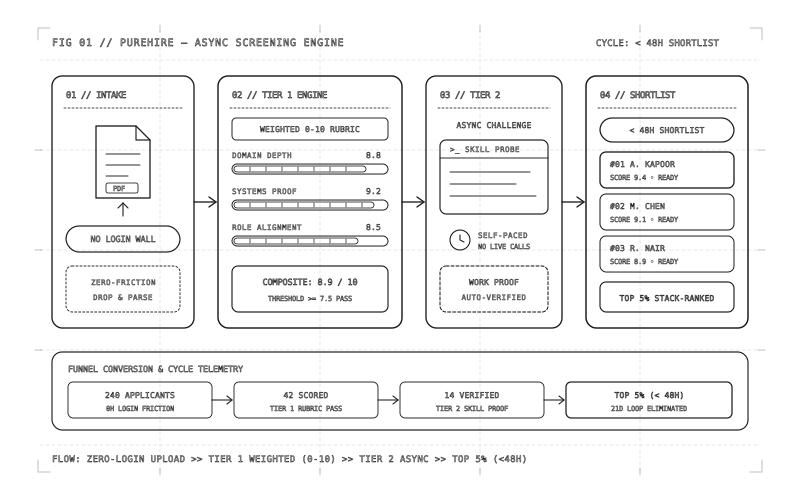
Our first architectural decision on Purehire.in was ruthless simplicity at the candidate edge. An applicant opening a Purehire job link does not hit a sign-up wall, a password policy, or a mandatory profile wizard. They read the role expectations, upload a PDF or DOC resume, and complete any role-specific screening prompt directly in one calm flow.
The moment their CV is submitted, the platform evaluates their background against the role criteria and returns transparent feedback on where their experience aligns and where gaps exist. Candidates are not left wondering whether their PDF vanished into a black hole for three weeks—and hiring managers stop losing top talent to form fatigue.
┌────────────────────────┐     ┌───────────────────────────┐     ┌──────────────────────────┐
│  Founder Inputs Rough  │ ──▶ │  Structured Role Spec &   │ ──▶ │  Public Zero-Login Link  │
│  Role Notes (2 mins)   │     │  Weighted Criteria (0–10) │     │  (30 Days / 250 Slots)   │
└────────────────────────┘     └───────────────────────────┘     └──────────────────────────┘
                                                                               │
                                                                               ▼
┌────────────────────────┐     ┌───────────────────────────┐     ┌──────────────────────────┐
│  Top-5% Shortlist Ready│ ◀── │  Tier 2: Async Skill      │ ◀── │  Tier 1: Instant 0–10    │
│  in Under 48 Hours     │     │  Challenge Verification   │     │  Criterion Fit Scoring   │
└────────────────────────┘     └───────────────────────────┘     └──────────────────────────┘
Two-Tier Asynchronous Screening: Criteria Scoring + Skill Challenges
Speed without rigor is useless; keyword matching alone just rewards candidates who stuff buzzwords into white text at the bottom of a PDF. To eliminate both manual reading fatigue and keyword gaming, Purehire separates evaluation into two clean asynchronous stages:
- Tier 1 — Instant 0–10 Criterion Role-Fit Scoring: Rather than inventing vague "black-box percentages," every role on Purehire compiles into explicit, weighted criteria—core technical capabilities, years of relevant delivery ownership, domain context, and non-negotiable constraints. Each incoming CV is scored deterministically against each criterion on a transparent 0–10 scale within seconds, complete with evidence notes explaining why a candidate earned an 8.4 instead of a 4.1.
- Tier 2 — Structured Asynchronous Skill Challenges: High-scoring applicants can be routed straight into a concise, role-specific asynchronous challenge—a short architecture prompt, a debugging scenario, or an operational prioritization exercise. Instead of scheduling fifteen repetitive 30-minute "introductory" phone calls to test basic competence, you inspect real work before putting a single invite on your calendar.
export interface RoleCriterion {
  id: string
  label: string
  weight: number // Sum of weights normalized to 1.0
  mustHave: boolean
  evidencePrompt: string
}

export interface CandidateEvaluation {
  candidateId: string
  overallScore: number // 0.0 to 10.0 weighted composite
  criterionBreakdown: Array<{
    criterionId: string
    score: number
    matchedEvidence: string
    gapNote?: string
  }>
  shortlistTier: 'top_5_percent' | 'review' | 'mismatch'
  evaluatedAtIso: string
}
Traditional Portals vs. Purehire.in: Funnel Economics
Across more than 15,000 candidates evaluated in live production on Purehire.in, the operational difference comes down to removing wasted manual loops for both sides of the table:
| Hiring Stage | Traditional Job Portals & $300/mo ATS | Purehire.in Asynchronous Engine |
|---|---|---|
| Job Setup & Spec Clarity | Blank text box; vague bullet points | Structured JD refined in seconds for Indian market norms |
| Candidate Application | Mandatory login wall; 60%+ drop-off | Zero-login PDF/DOC upload in under 2 minutes |
| Initial CV Screening | 20+ hours manually skimming 300+ resumes | Instant 0–10 criterion scoring with evidence breakdown |
| First-Round Validation | 15+ repetitive 30-min scheduling & phone calls | Asynchronous skill challenges completed on candidate's schedule |
| Time to Top-5% Shortlist | 2 to 3 weeks of inbox fatigue | Under 48 hours from role launch |
| Pricing Model | $300+/mo recurring seat contracts or 15–20% agency fees | ₹199 flat for 30 days / 250 slots (₹50 per 100 extra slots) |
Pricing Philosophy: Flat ₹199 for 30 Days, Zero Subscriptions
When we priced Purehire.in at ₹199 flat for a 30-day listing with 250 applicant slots (and ₹50 per 100 additional slots if a campaign goes viral), people asked how that could possibly make sense compared to enterprise SaaS pricing. The answer is architectural discipline.
By keeping the application lean—zero bloated enterprise workflows, clean stateless scoring pipelines, and static-first delivery—our unit cost per evaluated listing stays tiny. More importantly, ₹199 removes procurement friction completely. A founder in Kochi or a hiring lead in Bengaluru does not need finance approval or a demo call. You pay ₹199 once, post your role, let the two-tier engine separate signal from noise, and spend your week talking exclusively to the top 5%.
Hiring speed is rarely limited by a shortage of applicants—it is limited by the latency between receiving 300 resumes and identifying the 10 people actually qualified to do the job. Automate the sorting, verify with async work, and keep human conversations high-signal.