The Digital Sovereignty Playbook: Replacing 8 SaaS Subscriptions with a Private Workplace Suite
Every new hire silently triggers eight separate per-seat monthly invoices across Slack, Notion, Jira, Workspace, and Zendesk. Here is the 5-year TCO math and technical blueprint behind Own My Stack—a single-login private workplace suite hosted on servers you own.
The Silent Compounding of the "SaaS Seat Tax"
When a startup has four founders sitting around one table, renting software is frictionless. Ten dollars a month for email, twelve dollars for chat, ten dollars for a wiki, fifteen for project tracking—it barely registers on a credit card statement. Then the team grows to 15, 35, or 75 people, and the math turns upside down.
Every new engineer, support specialist, or contractor does not add one subscription; they multiply eight separate per-user bills simultaneously. Slack, Notion, Jira or Linear, Google Workspace or Office 365, Zendesk, private Git hosting, cloud file storage, and domain email routing quietly compound into ₹10L to ₹35L+ ($15,000 to $50,000+) every single year—and those prices only move in one direction when vendors revise tier thresholds or lock SSO behind "Enterprise" plans.
Worse than the invoice is the fragmentation. Your intellectual property—source code, client proposals, financial spreadsheets, support history, and internal SOPs—ends up scattered across eight external vendor clouds, governed by eight different privacy policies and eight separate permission panels.
The Data Custody Risk Nobody Audits Until Something Breaks
Consider what happens on a routine Friday afternoon when a contractor rolls off a project or an employee leaves the company. In a fragmented SaaS stack, an operations manager has to remember to revoke access in Google Workspace, Slack, Notion, Jira, GitHub, Zendesk, shared Drive folders, and external calendar shares. Miss one token or one shared Notion workspace invite, and confidential client records stay accessible outside your company perimeter.
For regulated, compliance-heavy, or client-confidential businesses—such as legal, taxation, healthcare, or enterprise consulting firms—having client files replicated across eight multi-tenant SaaS providers is an unnecessary surface area. That is why we built Own My Stack (originally engineered for clients like AjobTech as Core Node): a complete private workplace suite deployed directly onto virtual private servers or cloud accounts your company owns 100%.
Inside the Own My Stack Architecture
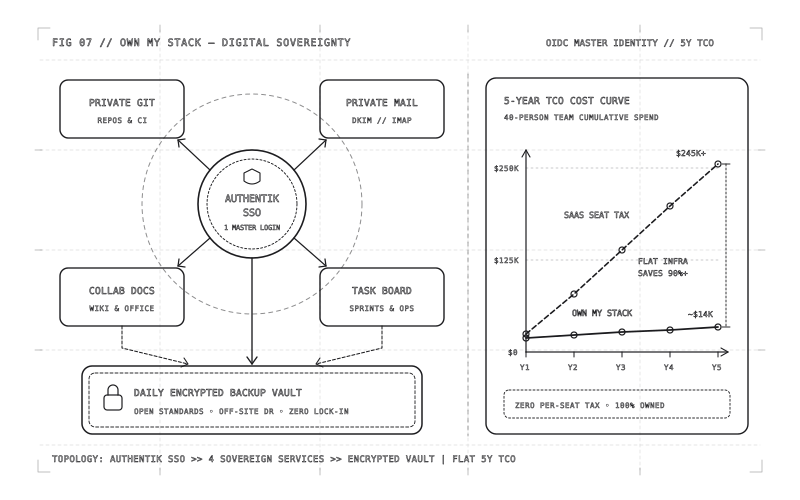
Own My Stack is not a fragile bundle of disconnected open-source scripts. It is an integrated, production-hardened workplace suite organized around one central identity spine and automated disaster recovery:
- Unified Single Sign-On (Master Login): One identity provider sits in front of every tool. Provisioning a new employee takes 60 seconds and immediately grants scoped access across email, chat, wiki, Git, and cloud drive. Offboarding revokes one master identity and terminates every active session across all eight applications simultaneously.
- Team Chat & Channels: Real-time threaded messaging, file sharing, and webhook integrations replacing Slack without message-history paywalls.
- Company Wiki, Tasks & Office Suite: Collaborative documentation, sprint boards, and browser-native docs, spreadsheets, and presentations replacing Notion, Jira, and Office 365.
- Private Cloud Drive, Calendar & Mail Routing: Encrypted team file storage, CalDAV/CardDAV calendar sync, and custom-domain mail infrastructure with DKIM, SPF, and DMARC configured properly.
- Private Git & Customer Helpdesk: Internal source repositories with role-based branch protection alongside a clean support ticketing desk replacing Zendesk.
- Daily Encrypted Off-Site Backups: Automated nightly snapshots encrypted client-side and replicated to an independent off-site object bucket—tested for clean point-in-time restoration.
                    ┌──────────────────────────────────────────┐
                    │       Team Member / Client Browser       │
                    └────────────────────┬─────────────────────┘
                                         │ HTTPS (TLS 1.3)
                                         ▼
                    ┌──────────────────────────────────────────┐
                    │   Reverse Proxy + Unified SSO Gateway    │
                    │   (1 Master Login = Instant On/Offboard) │
                    └──────┬─────────────┬─────────────┬───────┘
                           │             │             │
          ┌────────────────▼──┐  ┌───────▼─────────┐  ┌▼─────────────────┐
          │ Collaboration     │  │ Knowledge & Ops │  │ Engineering &    │
          │ • Team Chat       │  │ • Wiki & Docs   │  │ Customer Support │
          │ • Private Mail    │  │ • Task Boards   │  │ • Private Git    │
          │ • Shared Calendar │  │ • Office & Drive│  │ • Client Helpdesk│
          └────────────────┬──┘  └───────┬─────────┘  └┬─────────────────┘
                           └─────────────┼─────────────┘
                                         ▼
                    ┌──────────────────────────────────────────┐
                    │  Encrypted Daily Off-Site Backup Vault   │
                    │  (Open Standards • Zero Vendor Lock-In)  │
                    └──────────────────────────────────────────┘
Open Standards Mean Zero Lock-In
The sharpest objection CTOs raise against self-hosting is fear of trading one walled garden for a harder-to-manage private garden. That only happens if a platform traps data in proprietary schemas. Every component in Own My Stack stores data in open, portable, industry-standard formats: standard Git repositories, Markdown/HTML documents, SQL relational tables, standard IMAP/Maildir mailboxes, and CalDAV/ICS calendars. If your company reaches 500 staff and wants to migrate a single module to another provider later, every byte exports cleanly without hostage fees.
identity_provider:
  protocol: "oidc"
  session_ttl_hours: 12
  mfa_required: true
  offboard_action: "revoke_all_tokens_and_archive_mailbox"

backup_schedule:
  frequency: "02:00 UTC daily"
  encryption: "age-public-key"
  retention_days: 30
  offsite_target: "s3://private-vault-dr-mumbai/own-my-stack"
  verify_restore_drill: "monthly"
The 5-Year Total Cost of Ownership (TCO) Reality
Even after accounting for dedicated cloud server hosting and routine maintenance, owning your stack changes the cost curve from linear per-seat penalty to flat infrastructure overhead. Below is a realistic 5-year TCO comparison for a 40-person growing company replacing 8 commercial subscriptions (~$85–$110/user/month combined across chat, docs, project tracker, workspace suite, helpdesk, and Git seats):
| Cost Dimension (40-Person Team) | 8 Commercial SaaS Tools | Own My Stack (Private Cloud) |
|---|---|---|
| Monthly Software Licensing | ~$3,600 / mo ($90/seat avg) | $0 / mo (Zero per-user license fees) |
| Private Cloud Compute & Off-Site Backups | Included in vendor markup | ~$140–$220 / mo (Flat infrastructure) |
| Year 1 Total Spend (incl. setup) | ~$43,200 (₹36L+) | One-time setup + ~$2,200 annual hosting |
| 5-Year Cumulative Spend (with 15% team growth) | $245,000+ (₹2.0Cr+) | ~$12,000–$16,000 total infrastructure |
| Data Residency & Offboarding Control | 8 vendor clouds; manual seat cleanup | 100% private server; 1-click SSO revocation |
Software licenses should not act as a growth tax on headcount. When you own your workplace infrastructure behind a single unified login, hiring your 40th employee costs almost nothing extra in tooling—and your company's institutional memory never leaves your balance sheet.