Why Most Customer Portals Fail (And How Fast, Calibrated Software Earns Trust)
A slow, confusing client portal forces customers back into email threads and WhatsApp follow-ups—and silently slows down invoice payments. Here is the engineering blueprint behind portals that clients actually enjoy opening.
The Silent Trust Leak Inside Most B2B Services
Consider the contradiction inside many high-performing service, logistics, financial, and SaaS companies. Their actual product or advisory work is world-class. Yet the moment a new client signs the contract, they are handed a login link to a clunky customer portal that feels like an internal spreadsheet bolted onto a template from 2014.
Within two weeks, clients stop opening the portal completely. Instead, they email your account manager asking: "Can you resend last month's invoice PDF?" or message on WhatsApp: "Where does our deliverable stand right now?" Your portal did not fail because customers prefer email; it failed because the software treated their time as an afterthought.
The Three Friction Points That Kill Portal Adoption
When we audit underused client portals, three exact engineering and UX failures show up almost every time:
- The 4-Second Loading Spinner: Every tab click triggers unindexed database joins across billing, messages, and file metadata, leaving the user staring at a blank white spinner for four seconds. Slow interfaces feel unreliable—especially when money or deadlines are involved.
- The Buried Invoice & Document Maze: A CFO logging in just wants one thing: click once, download the GST/VAT invoice PDF, and approve payment. Instead, portals hide documents behind three nested menus, broken pop-ups, or expired external links.
- The Broken Mobile Layout: Busy clients open milestone updates and approval alerts straight from email or WhatsApp on their phones. Horizontal scrollbars, overlapping tables, and microscopic buttons guarantee they close the tab and reply "just send it on email" instead.
Why Passwordless Magic Links Beat Password Walls
Unlike internal staff who log into work tools every morning, most customers open a vendor portal once a week or once a month. Forcing an occasional client to invent a 14-character password with symbols—and then fail a password-reset loop three weeks later—causes more than 40% of login drop-offs.
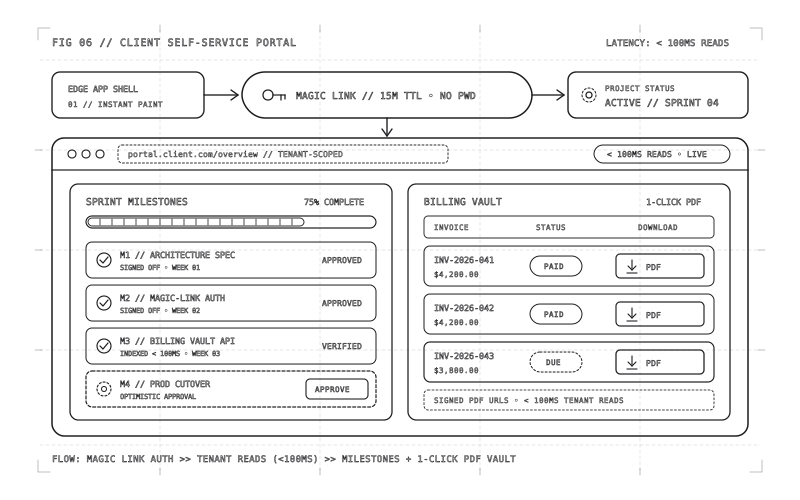
Replacing mandatory passwords with single-use expiring magic links (or one-click SSO for enterprise accounts) removes the biggest front-door barrier immediately. A client clicks an authenticated link in their email notification, lands directly on the exact milestone or invoice requiring review, and completes the action in 15 seconds.
A great customer portal answers two questions in under two seconds: "Where does my work stand today?" and "What do you need from me next?"
The High-Trust Portal Architecture
Earning genuine client adoption requires pairing calm Swiss editorial clarity with disciplined backend performance:
- Static Client Shell + Sub-100ms Indexed Reads: Pre-render the navigation shell at the edge so the layout paints instantaneously, then hydrate only the client's current milestones, open action items, and billing summary from indexed read queries returning in under 100ms.
- Optimistic UI Updates for Approvals: When a client approves a scope milestone or confirms a delivery receipt, reflect the confirmed state immediately while persisting the immutable audit record cleanly in the background.
- One-Click Document & Billing Clarity: Put downloadable PDFs, payment status, and upcoming milestone dates at the top level—zero nested hunting required.
- Responsive From Phone to Desktop: Every approval card, invoice row, and timeline step reflows cleanly on a 375px smartphone screen.
┌─────────────────────────┐     ┌───────────────────────────┐     ┌─────────────────────────┐
│ Client Opens Alert Link │ ──▶ │ Edge Static App Shell     │ ──▶ │ Magic-Link Session Gate │
│ (Email / WhatsApp)      │     │ (Instant First Paint)     │     │ (15-Min Expiry • No Pwd)│
└─────────────────────────┘     └───────────────────────────┘     └────────────┬────────────┘
                                                                               │
                                                                               ▼
┌─────────────────────────┐     ┌───────────────────────────┐     ┌─────────────────────────┐
│ Actionable Dashboard    │ ◀── │ Sub-100ms Indexed Reads   │ ◀── │ Tenant-Scoped Context   │
│ • Live Milestones       │     │ (Milestones • Invoices)   │     │ (Strict Row Isolation)  │
│ • 1-Click Invoice PDFs  │     └───────────────────────────┘     └─────────────────────────┘
│ • Optimistic Approvals  │
└─────────────────────────┘
export interface PortalSummaryResponse {
  tenantName: string
  activeMilestones: Array<{
    id: string
    title: string
    status: 'in_progress' | 'awaiting_client' | 'completed'
    dueDateIso: string
  }>
  recentInvoices: Array<{
    invoiceNumber: string
    amountFormatted: string
    status: 'paid' | 'due'
    signedPdfUrl: string // Time-limited pre-signed download link
  }>
  queryLatencyMs: number
}

// Magic-link verification issues an HttpOnly cookie scoped strictly to the tenant
export async function verifyMagicLinkToken(tokenHash: string): Promise<{
  sessionCookie: string
  redirectPath: string
}> {
  // Single-use token invalidated atomically inside a DB transaction
  return { sessionCookie: 'fnd_portal_sess=...', redirectPath: '/portal/overview' }
}
Business Impact: Broken Portals vs. Calibrated Self-Service
| Operational Metric | Legacy Afterthought Portal | High-Trust Calibrated Portal |
|---|---|---|
| Client Login Completion | 40%+ drop-off at forgotten password screens | 90%+ smooth entry via expiring magic links |
| Invoice Time-to-Payment | Delayed by "please resend the PDF" email loops | Cut by days via 1-click PDF & payment clarity |
| Status-Check Support Tickets | Constant inbox & WhatsApp interruptions | 40%+ reduction in routine status inquiries |
| Mobile Usability | Pinch-to-zoom tables & broken download buttons | Clean single-column cards & instant mobile actions |
| Client Retention & Referrals | Portal feels like administrative friction | Reinforces brand precision & operational trust |
Your customer portal is the visible surface of your company's operational reliability. Strip away password walls, load key status and invoice PDFs in under 100ms, and design for a phone screen first—and self-service becomes a competitive advantage that speeds up cash collection.