Calm Cloud Deployments: The 4 Operational Guardrails Every Growing Team Needs
If your team avoids shipping software on Fridays—or depends on one engineer remembering manual SSH commands—your delivery pipeline is a business bottleneck. Here are the four automated guardrails that make production releases calm and predictable.
Ending "Friday Deployment Anxiety"
You can measure the operational maturity of a software business by watching what happens when a founder asks for a minor wording update or bug fix on a Thursday afternoon. In fragile teams, the room goes quiet: "Let's wait until Monday morning—if something breaks during deployment, nobody wants to spend the weekend fixing the server."
That hesitation has a steep hidden cost. Features sit unshipped for days, bug fixes pile up into risky "big bang" releases, and worst of all, deployment knowledge lives inside one senior engineer's head as a fragile ritual of SSH commands and manual restarts.
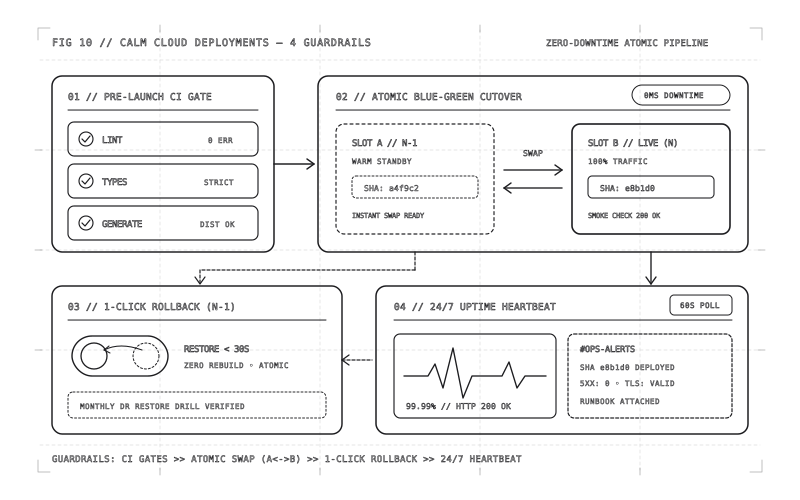
Calm engineering teams ship routine updates at 2:00 PM on a Tuesday—or a Friday—without raising anyone's heart rate. They achieve that not through heroics, but by putting four automated guardrails around every release.
Guardrail 1: Automated Pre-Launch Safety Checks
Human code review should focus on business logic and product clarity—never on spotting missing imports, broken type contracts, or syntax errors. Before any code merges to your production branch, an automated CI pipeline should enforce four non-negotiable gates: linting, strict TypeScript typechecking, a complete production build or static generation pass, and automated smoke checks against critical routes.
If any check fails, the merge button stays locked. Regressions get caught in three minutes on a developer's pull request rather than three hours later by an angry customer. Pairing CI checks with automatic preview URLs for every pull request also lets founders and designers inspect UI changes in a real browser before anything touches production.
Guardrail 2: Zero-Downtime Atomic Releases & Instant Rollback
Taking a site offline for "scheduled maintenance" to upload files or restart a server belongs in 2012. Whether you run a static site on edge storage or a dynamic backend API, every release should be atomic: build and verify the new artifact completely in staging, run automated health checks, and switch live traffic in a single cutover—keeping the previous working build ready for a one-click rollback in under 30 seconds.
Just as important is separating build-time configuration from runtime secrets. Never bake production database credentials or webhook keys into git commits or static bundles; inject them cleanly from encrypted environment vaults so rotating a compromised key takes seconds without rewriting code.
┌────────────────┐    ┌───────────────────────┐    ┌────────────────────────┐
│ Pull Request   │ ─▶ │ Automated CI Gates    │ ─▶ │ Build Immutable        │
│ Pushed to Git  │    │ Lint • Types • Build  │    │ Artifact & Smoke Check │
└────────────────┘    └───────────────────────┘    └───────────┬────────────┘
                                                               │
                                                               ▼
┌────────────────┐    ┌───────────────────────┐    ┌────────────────────────┐
│ Proactive      │ ◀─ │ Instant 1-Click       │ ◀─ │ Zero-Downtime Cutover  │
│ Slack Alerts   │    │ Rollback Ready (N-1)  │    │ (Blue-Green / Atomic)  │
└────────────────┘    └───────────────────────┘    └────────────────────────┘
name: Production Safety & Zero-Downtime Release
on:
  push:
    branches: [main]

jobs:
  verify_and_ship:
    runs-on: ubuntu-latest
    steps:
      - uses: actions/checkout@v4
      - uses: pnpm/action-setup@v4
      - run: pnpm install --frozen-lockfile
      - run: pnpm lint
      - run: pnpm typecheck
      - run: pnpm generate
      - name: Atomic Deploy & Health Verification
        run: ./scripts/atomic-deploy-and-smoke-check.sh
Guardrail 3: Proactive Error & Uptime Alerting
Leadership should never learn that checkout is broken or an SSL certificate expired from a customer support email. Lightweight synthetic uptime checks polling key endpoints every 60 seconds, paired with structured application error tracking routed to a dedicated ops-alerts Slack channel, surface problems within seconds—complete with the exact release commit that changed.
To prevent alert fatigue, separate actionable high-severity signals (5xx responses, failed webhook deliveries, expiring TLS certificates, disk capacity crossing 80%) from noisy informational logs. Every alert in Slack should map directly to a short, plain-English runbook telling any on-call engineer how to inspect or roll back in under five minutes.
Guardrail 4: Scheduled Disaster Recovery Drills
Every company claims to have "daily backups." Surprisingly few have ever tested restoring one onto a clean database. Silent backup failures—corrupted dumps, missing encryption keys, expired credentials—only show up during real emergencies. Scheduling an automated monthly restore drill into an isolated staging database turns backup confidence from an assumption into a verified metric.
A practical 15-minute monthly drill checks three numbers: how long the snapshot takes to decrypt and restore (Recovery Time Objective), whether the latest row timestamps match expectations (Recovery Point Objective), and whether the application boots cleanly against the restored data without manual patching.
The 8-Point Founder Cloud Readiness Checklist
| Check | Guardrail Area | What "Healthy" Looks Like |
|---|---|---|
| 1 | Pre-Merge Verification | Lint, strict typecheck, and production build pass automatically on every PR |
| 2 | Zero Tribal Knowledge | Any engineer can deploy cleanly from a single documented push-button workflow |
| 3 | Zero-Downtime Cutover | Live users never see 502/maintenance pages during routine releases |
| 4 | 1-Click Rollback | Previous release artifact can be restored live in under 60 seconds |
| 5 | Secret Hygiene | API keys and credentials stored in encrypted environment vaults—never in Git |
| 6 | Synthetic Monitoring | External health checks verify critical pages and forms every 60 seconds |
| 7 | Actionable Alerting | Slack/email alerts notify the team before customers encounter persistent errors |
| 8 | Verified Restore Drills | Encrypted daily backups tested via scheduled monthly restoration checks |
Reliability is invisible when it works—and priceless for customer trust. Replace nervous manual deployments with automated pre-launch checks, atomic swaps, live alerting, and tested backup restores so shipping software feels calm every day of the week.