Architecture That Scales Without Breaking: Why We Choose Modular Simplicity Over Microservice Sprawl
Premature microservices saddle small engineering teams with distributed network failures, connection pool exhaustion, and bloated cloud bills long before they ever reach hyperscale. Here is why a typed Modular Monolith paired with a Static Edge outperforms sprawl.
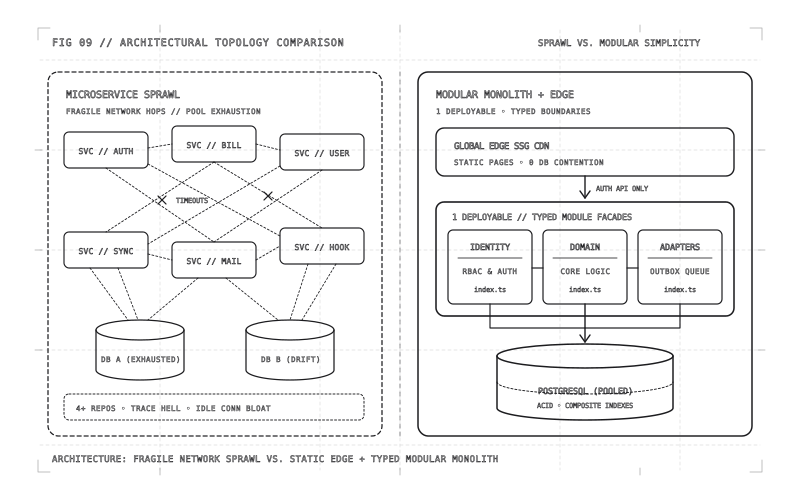
The Hidden Tax of Premature Microservices
Every few months, we get called in to audit a promising SaaS product whose engineering velocity has ground to a halt. The company has six developers, two thousand active customers, and somehow twelve separate microservices, three message brokers, a service mesh, and an AWS bill higher than their office rent.
Nobody set out to over-engineer the system. Usually, an early architect read how Netflix or Uber organizes hundreds of engineers and copied the topology before the product had even stabilized its core domain. The result is microservice sprawl—where shipping one new column on a customer invoice requires coordinated pull requests across four repositories, two schema migrations, and an afternoon of chasing trace IDs across distributed logs.
Worse, distributed sprawl introduces failure modes that barely exist in a cohesive codebase: partial network timeouts between services, out-of-order webhook deliveries, and database connection pool thrashing when ten small services each open dozens of idle connections against one central database.
Modular Monolith + Static Edge: Calm Structural Leverage
At Febin & Dale Ventures, our default blueprint for scalable web platforms and SaaS products is the combination of a Static Edge and a Typed Modular Monolith:
- Static Edge for Read-Heavy Surfaces: Marketing sites, documentation portals, catalogs, and editorial pages (including this very Nuxt 4 static site) are pre-rendered at build time and served directly from global CDN edge nodes. Public traffic spikes cost virtually zero compute and never touch a database connection pool.
- Modular Monolith for Core Business Logic: Authenticated dashboards, billing workflows, user permissions, and background jobs live inside a single deployable application split into strict, domain-owned modules—for example,
billing/,identity/,projects/, andintegrations/. - Explicit Module Boundaries: Modules communicate exclusively through typed public service interfaces, never by reaching directly into another module's database tables. If one domain genuinely hits independent scaling constraints years later, extracting it into its own worker takes days because the boundary already exists.
┌─────────────────────────────────────────────────────────────────────────┐
│                        Global Edge CDN (Static SSG)                     │
│   Instant Sub-Second Pages • Zero DB Contention • Immutable Assets      │
└───────────────────────────────┬─────────────────────────────────────────┘
                                │ Authenticated API / App Actions Only
                                ▼
┌─────────────────────────────────────────────────────────────────────────┐
│                     Typed Modular Monolith (1 Deployable)               │
│  ┌───────────────┐   ┌───────────────┐   ┌───────────────────────────┐  │
│  │ Identity &    │   │ Core Domain   │   │ Integration Adapters      │  │
│  │ Permissions   │   │ Workflows     │   │ (Stripe, HubSpot,         │  │
│  │ Module        │   │ Module        │   │  QuickBooks, Webhooks)    │  │
│  └───────┬───────┘   └───────┬───────┘   └─────────────┬─────────────┘  │
└──────────┼───────────────────┼─────────────────────────┼────────────────┘
           └───────────────────┼─────────────────────────┘
                               ▼
┌─────────────────────────────────────────────────────────────────────────┐
│        Relational Database (PostgreSQL) + Pooled Connections            │
│   Indexed Queries • ACID Transactions • Clean Foreign-Key Integrity     │
└─────────────────────────────────────────────────────────────────────────┘
Database Discipline Beats Horizontal Complexity
Most "scaling bottlenecks" we diagnose have nothing to do with needing twenty application servers; they come from missing composite indexes, N+1 query loops inside dashboards, and unpooled database connections. A single properly indexed PostgreSQL instance behind a connection pooler handles tens of thousands of transactions per minute effortlessly—while giving you full ACID transactions so billing and inventory states never drift apart.
Equally important is isolating third-party APIs like Stripe, HubSpot, and QuickBooks behind idempotent integration adapters. When an external provider rate-limits or hiccups, your core database transaction commits cleanly first, and a durable outbox or retry queue delivers the external sync safely without locking up a user's browser request.
Enforcing Module Boundaries Without Separate Repositories
Critics of monoliths often worry that a single codebase inevitably turns into spaghetti where every file imports every other file. That only happens when teams skip structural discipline. Inside a typed Modular Monolith, we enforce boundaries with three lightweight rules that cost zero infrastructure overhead:
- Public Module Facades: Every domain directory exposes a single
index.tsfacade. Other modules may only call exported service functions—never reach into internal helpers or raw ORM models belonging to another domain. - Automated Lint Boundary Checks: A simple ESLint import-restriction rule fails the build immediately if
billing/tries to import directly fromidentity/internal/. - Extract Only When Workload Physics Demand It: Background jobs that consume bursty memory or CPU—such as generating large PDF reports or ingesting heavy webhook floods—can run as a separate worker process built from the exact same repository before you ever consider splitting databases or teams.
-- Clean relational indexing + idempotency table for reliable integrations
CREATE TABLE integration_outbox (
  id              UUID PRIMARY KEY,
  provider        TEXT NOT NULL,          -- 'stripe' | 'hubspot' | 'quickbooks'
  idempotency_key TEXT NOT NULL UNIQUE,   -- prevents duplicate invoices or deals
  payload         JSONB NOT NULL,
  status          TEXT NOT NULL DEFAULT 'pending',
  attempts        INT NOT NULL DEFAULT 0,
  next_retry_at   TIMESTAMPTZ NOT NULL DEFAULT NOW(),
  created_at      TIMESTAMPTZ NOT NULL DEFAULT NOW()
);

CREATE INDEX idx_outbox_pending_schedule
  ON integration_outbox (status, next_retry_at)
  WHERE status IN ('pending', 'retrying');
Modular Monolith vs. Microservice Sprawl
| Architectural Dimension | Premature Microservice Sprawl | Modular Monolith + Static Edge |
|---|---|---|
| Cross-Feature Changes | 4+ repos, versioned API contracts, coordinated rollouts | Single atomic PR with compile-time TypeScript checks |
| Data Consistency | Eventual consistency bugs & compensating sagas | Native ACID database transactions across domains |
| Debugging & Onboarding | Requires distributed tracing just to follow one request | One codebase, clear module folders, plain-English traces |
| Cloud Hosting Footprint | Multiple clusters, gateways, queues, idle RAM overhead | Static edge CDN + lean pooled app instances |
| Future Extraction Path | Already locked into complex network boundaries | Extract any heavy module cleanly when traffic actually proves it |
Organize your architecture around the size of your engineering team and the clarity of your data model—not imaginary hyperscale problems. A well-structured Modular Monolith with clean database indexes and a static edge will outship and out-scale microservice sprawl for your first million users.