Native Mobile App or Responsive Web App? What Growing Businesses Get Wrong
Before committing ₹15L–₹35L+ ($20k–$50k) to separate iOS and Android apps, check whether your customers actually want another App Store download—or a sub-second responsive web platform they can open from a single link.
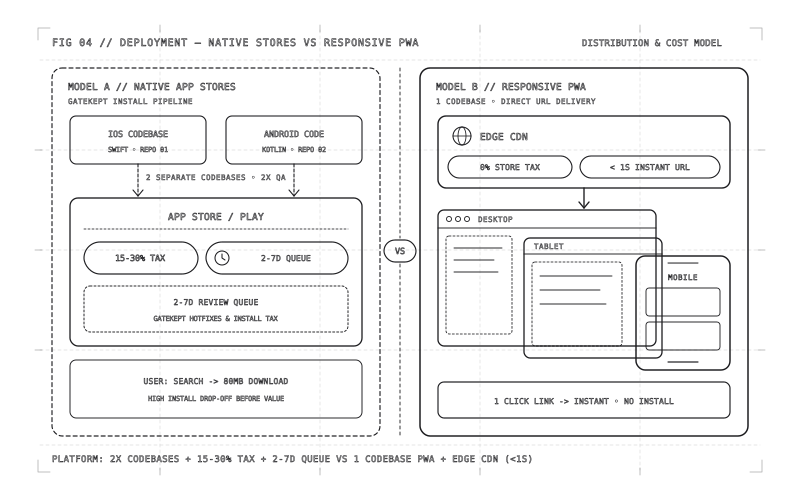
The Expensive Reflex: "We Need an iOS and Android App"
At least twice a month, a growing business approaches us with a budget between ₹15L and ₹35L+ ($20,000 to $50,000) earmarked for building native iOS and Android applications. When we ask how customers currently discover and interact with their business, the answer is almost always the same: a link shared on WhatsApp, a Google search result, an email invoice, or a QR code printed at a physical counter.
Think about your own habits as a customer. If a clinic, B2B supplier, logistics vendor, or boutique service asks you to visit the App Store, wait for a 90 MB download, type your Apple ID password, and create an account just to book an appointment or check an order status—what do you do? Most people abandon the flow within 20 seconds.
More than 70% of businesses building native mobile apps do not actually have a native-mobile problem. They have a mobile-accessibility problem—and solving it through App Stores adds massive cost and friction they never budgeted for.
The App Store Reality Check: Three Hidden Taxes
Before locking your roadmap into Apple's App Store and Google Play, account for the ongoing operational taxes that show up after launch day:
- The 15–30% Platform Transaction Tax: If your product sells digital services, subscriptions, or content inside an iOS or Android binary, app store billing rules frequently demand a 15% to 30% cut of gross revenue—eclipsing normal payment gateway fees by an order of magnitude.
- 2-to-7 Day Release Review Delays: When you spot a checkout bug on a web platform, an engineer pushes a fix and every user sees it in 60 seconds. On native app stores, urgent fixes sit in review queues for days—and even after approval, half your users stay on outdated cached versions for weeks.
- The Multi-Codebase Maintenance Multiplier: Even with shared UI libraries, supporting iOS, Android, and a web admin portal means tripling device testing, OS upgrade breakages every September, and certificate renewals across three distribution surfaces.
When a Native Mobile App Is Genuinely Worth the Investment
Native apps are not obsolete—they are simply specialized tools. You genuinely need a native (or cross-platform native-compiled) app when your product depends on capabilities browsers still cannot deliver reliably:
- Background Hardware & Sensor Access: Continuous background Bluetooth Low Energy (BLE) pairing with medical wearables, factory IoT probes, or thermal receipt printers.
- True Offline-First Field Syncing: Delivery riders, agricultural inspectors, or warehouse auditors working inside zero-connectivity basements who capture dozens of photos and sync conflict-free queues hours later.
- High-Frequency Habit Loops: Consumer media, fitness trackers, or messaging apps where daily lock-screen widgets, instant camera overlays, and persistent background notifications drive core retention.
┌──────────────────────────────────────────────┐
│  "Should We Build iOS & Android Apps?"       │
└──────────────────────┬───────────────────────┘
                       ▼
┌──────────────────────────────────────────────┐   Yes   ┌───────────────────────────┐
│ Requires background Bluetooth/NFC sensors,   │ ──────▶ │ BUILD NATIVE /            │
│ deep offline field sync, or daily OS widgets?│         │ CROSS-PLATFORM MOBILE APP │
└──────────────────────┬───────────────────────┘         └───────────────────────────┘
                       │ No
                       ▼
┌──────────────────────────────────────────────┐   Yes   ┌───────────────────────────┐
│ Do customers reach you via links, QR codes,  │ ──────▶ │ BUILD RESPONSIVE WEB +    │
│ WhatsApp, search, or work across laptops?    │         │ INSTALLABLE PWA           │
└──────────────────────────────────────────────┘         │ (1 Codebase • <1s Load)   │
                                                         └───────────────────────────┘
Native vs. Cross-Platform vs. Responsive Web / PWA
Modern Responsive Web Apps and Progressive Web Apps (PWAs) have closed almost every usability gap that pushed businesses toward native apps a decade ago. They install onto mobile home screens in two taps, support responsive touch gestures, and work seamlessly across iPhone, Android, iPad, and desktop monitors from one single codebase:
| Platform Strategy | Native iOS & Android | Cross-Platform (Flutter / RN) | Responsive Web App / PWA |
|---|---|---|---|
| Typical Build Cost | Highest (2 separate mobile builds) | Moderate-High (1 shared app + store ops) | Lowest (1 codebase across web & mobile) |
| First-Time User Friction | High (App Store search + 90MB install) | High (App Store install gate required) | Zero (opens instantly from any URL or QR) |
| Urgent Bug Fix Speed | 2–7 days awaiting store review | 2–7 days (unless minor JS OTA patch) | Under 2 minutes; instant for 100% of users |
| App Store Fees | 15–30% on qualifying digital sales | 15–30% on qualifying digital sales | 0% store tax (standard gateway rates only) |
| Desktop & Tablet Support | Requires a separate web portal anyway | Weak on desktop browsers without extra work | Native support from 320px phone to 4K screen |
| Hardware / Offline Depth | Maximum (background sensors & local DB) | Strong for most sensors & offline queues | Basic camera, GPS, and light asset caching |
The Sub-Second Responsive Web & PWA Pattern
If your customers already open links on mobile browsers—or log in from both phones in the field and laptops at a desk—a static-first responsive web app paired with a lightweight PWA manifest and service worker delivers app-like speed without store gatekeepers:
// public/manifest.webmanifest — enables instant "Add to Home Screen" without App Store fees
{
  "name": "Client Operations Portal",
  "short_name": "OpsPortal",
  "start_url": "/dashboard?source=pwa",
  "display": "standalone",
  "background_color": "#F7F7F5",
  "theme_color": "#1C1C1F",
  "icons": [
    { "src": "/icons/icon-192.png", "sizes": "192x192", "type": "image/png" },
    { "src": "/icons/icon-512.png", "sizes": "512x512", "type": "image/png" }
  ]
}

// sw.js — cache static app shell for sub-second repeat opens on mobile networks
const SHELL_CACHE = 'portal-shell-v1'
self.addEventListener('fetch', (event) => {
  if (event.request.mode === 'navigate') {
    event.respondWith(
      fetch(event.request).catch(() => caches.match('/offline.html')),
    )
  }
})Ship where your customers already click. Unless your business genuinely depends on background Bluetooth hardware or zero-signal field syncing, a sub-second responsive web platform beats two native app codebases on launch speed, adoption, and five-year ROI every single time.